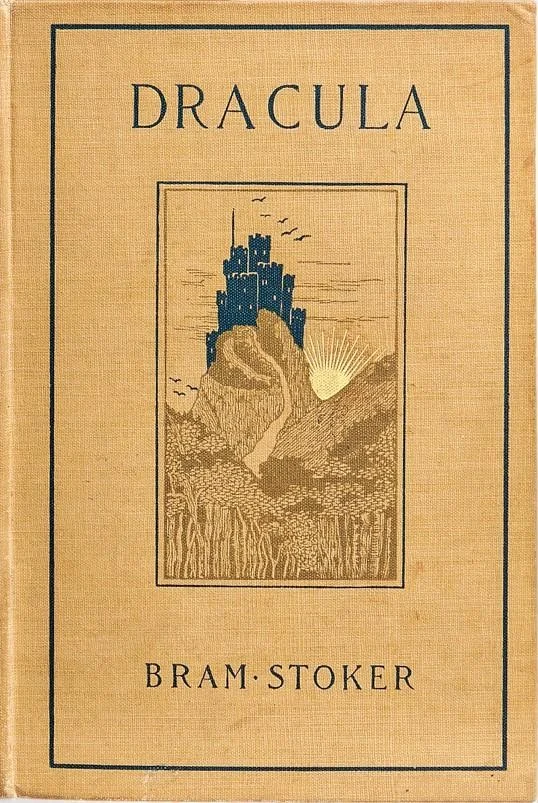
Bram Stoker’s Dracula is the epitome of Gothic literature. A work with a sombre yet undeniably compelling atmosphere, it defines the canon of the legendary vampire figure: from his appearance and supernatural abilities to his absolute aversion to garlic, communion wafers and crucifixes.
The young Jonathan Harker is sent to Transylvania to finalise the last formalities regarding the purchase of a London residence by the noble Count Dracula. His relationship with his host gradually becomes more ambiguous, mysterious and dangerous, laying the foundations for the escalating sense of unease that characterises the entire narrative. Overall, we learn of the events through a mosaic of letters, which take turns adopting the perspective of various characters, including Harker himself, his fiancée Mina and Professor Van Helsing.
As the story unfolds, we are confronted with a growing realisation of Dracula’s true nature and the inherent complexity of the eternal struggle between good and evil, faith and reason: medicine, science, psychology, religion and superstition must join forces in the face of the vampire’s inexplicable evil, and his ancestral power that causes even the steadiest of souls to waver. Amidst this arduous journey of lofty discourse, characters of rare emotional depth emerge, amongst whom the gentle and suffering portrayal of Mina stands out.
The cinema, captivated precisely by this thematic, emotional and evocative intensity, has repeatedly tackled Stoker’s work, giving us at least four masterpieces: in 1992, Francis Ford Coppola’s Bram Stoker’s Dracula, as well as three Nosferatu films (F.W. Murnau’s in 1922, Werner Herzog’s in 1979, and Robert Eggers’ in 2024). This is a sign that the legend of the vampire, as Stoker tells it, is eternal; it shows no sign of dying out, either on the page or on the screen.