“Black Lions, Roman Wolves”: Haile Gerima’s cry of accusation against Italian colonialism in Ethiopia
The Ethiopian director’s anti-imperialist epic about Mussolini’s military campaign in Africa
by Matteo Lagomarsini
On the Axum Stele, a millennia-old obelisk looted by Italian troops during the Fascist invasion of Ethiopia in 1935 and reinstalled in Rome in 1937, the Ethiopian director Haile Gerima manages to make out an inscription that “a tenacious Ethiopian” left at its base: “What legacy can one be proud of?“. Reflecting on this question, Gerima has a vision: his compatriot Abebe Bikila, the gold medallist marathon athlete at the 1960 Rome Olympics, running through the streets of the capital – renamed after the stages of the disastrous military campaign he witnessed as a child (Adwa, Ambar Adom, Gondar…) — passes by the memorial and, before sprinting towards the victory that brought redemption to a nation, casts a fleeting glance at the director.
Presented at the festival Piccolo Grande Cinema in Milan, Haile Gerima’s thirty-year body of work Black Lions, Roman Wolves, a monumental account of the Italo-Ethiopian War and the resistance to Fascist occupation between 1935 and 1942, is also, in some ways, a race. It is a frantic race against time: the time of remembrance, the one which emerges from the accounts and first-hand testimonies of the surviving Ethiopian partisans interviewed by Gerima, constituting the main leit-motif that accompanies the whole film; and the time of History, understood as a Western prerogative of the state (Italian, English, French) which possesses it, both materially and ideologically, in the form of an archive. Gerima knows that, without memory, what risks prevailing is the narrative of a time-eater State, which aims to abolish the archive and numb the past in order to evade any sense of obligation and reduce history to a single, incomplete, false interpretation (in this regard, it suffices to note that Gerima was denied access to the main section of the LUCE archive on Ethiopia). And so, the stories of the survivors are inevitably accompanied by Italian archive footage, which, whilst tainted by a colonial and racist mindset, nevertheless retains within it a latent potential to subvert that very mindset, a potential brought to life in the film through the continuous shot-reverse shot between the accounts of war crimes given by those who lived through them and the footage captured by those who filmed them.
History thus comes full circle: a war veteran, recalling the masses of dead piled one on top of another following the poison gas attacks by the Fascist air force in Maychew, says despondently, “It’s hard to believe when I tell the story now.” The images of those corpses, however, immediately flash before our eyes, as an irrefutable proof of what has happened, despite Italian denialism of war crimes in Africa still rages. Throughout the film, there is a rigorous style and a relentless pace, which leave no room for any kind of negotiation regarding the past. In this sense, the soundtrack takes on a fundamental role, functioning as a device similar to the visual archive, constantly keeping the narrative in tension between two opposing poles: on the one hand, the obsessive recurrence of fascist songs, speeches by Mussolini and quotations from D’Annunzio; on the other, Ethiopian war songs, verses written by Gerima’s father (a playwright and partisan), and funeral dirges; jarring and cacophonous juxtapositions aimed at demystifying, once again, the fascist myth surrounding the Ethiopian campaign.
Black Lions, Roman Wolves is a nine-hour film divided into five parts, in which the river of memory bursts its banks, sweeping away every barrier. Gerima takes care to leave no stone unturned and nothing unsaid, from the Italian intrigues of the 1920s leading up to the invasion, to the inaction of the League of Nations, to the complicity of other imperialist powers, to the occupation and the resistance (in which women played a leading role); from the international and anti-imperialist solidarity shown by African Americans, to the guerrilla warfare in the countryside and, finally, to victory and liberation, against the backdrop of post-colonial Ethiopia’s still-open wounds.
During those same years, the philosopher Walter Benjamin wrote: ‘Not even the dead will be safe from the enemy, if he wins. And this enemy has never ceased to win.’ Whilst the Ethiopians managed to defeat Mussolini’s fascism, its legacy continues to exist in Western archives, in its entrenchment within a memory that has never truly been re-examined, in the post-fascist justification of its crimes or, conversely, in denialism. By reconstructing a legacy of which we can be proud, Black Lions, Roman Wolves thus carries out its act of resistance by safeguarding its dead and, in so doing, redeeming history as a whole.
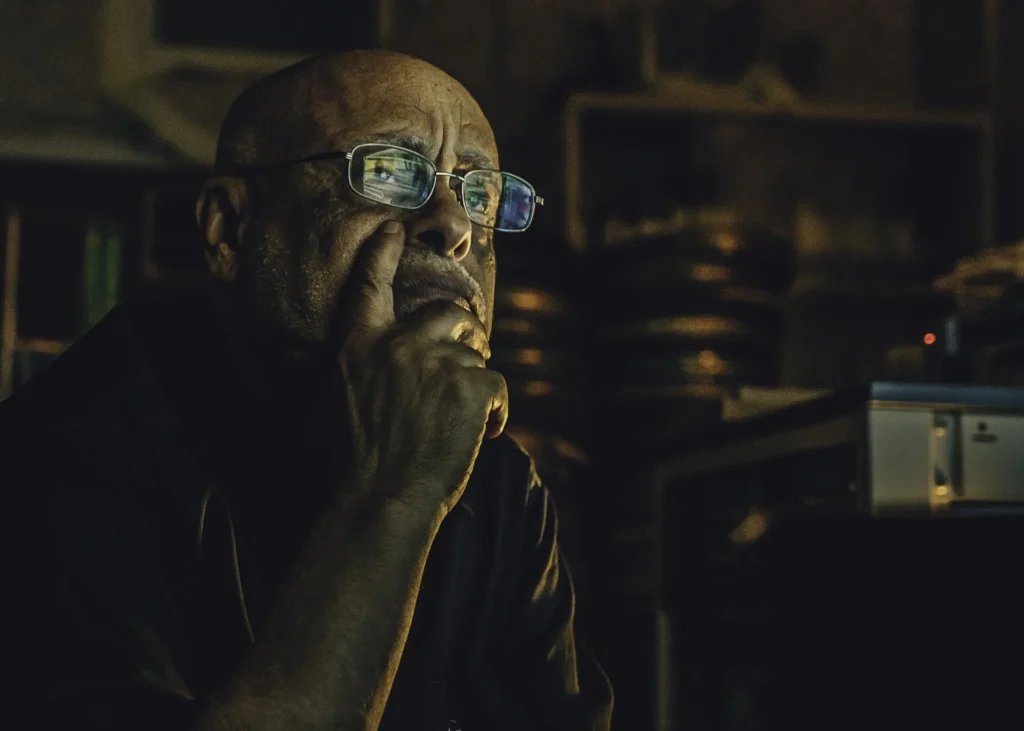
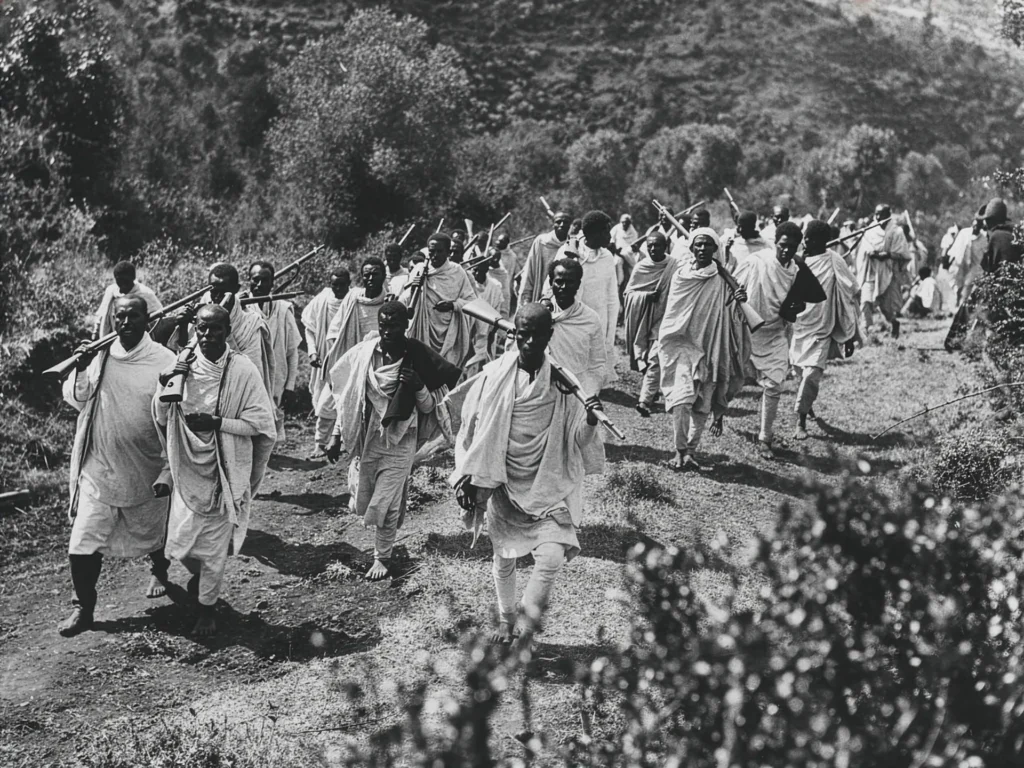
A scene from “Black Lions, Roman Wolves” by Haile Gerima. Above, the director portrayed in a picture by Melkestadek
What was the Ethiopian War
The Ethiopian War was a military campaign waged by the Fascist regime between October 1935 and May 1936. The Kingdom of Ethiopia under Haile Selassie was at the time one of two independent African states (alongside Liberia), and a member of the League of Nations. The Fascist invasion of Ethiopia was part of a long series of preparations undertaken by the regime as early as the 1920s, conceived as the ideal redemption for Italy’s first failed military campaign in Ethiopia, which saw the Kingdom’s troops under the Crispi government suffer a resounding defeat at Adwa in 1896. From 1936, Ethiopia, together with Eritrea and Somalia, formed the colony of Italian East Africa, which ceased to exist de facto in 1941 but formally in 1947.
Who is Haile Gerima
Haile Gerima (1946) is an independent filmmaker and professor of film at Howard University in Washington, D.C. Born and raised in Ethiopia, he emigrated to the United States in 1967, moving first to Chicago and then to Los Angeles, where he followed in the footsteps of his father, a playwright and screenwriter, by studying at the UCLA School of Theater, Film, and Television. There, he joined a group of African American, Native American, Chicano, Asian, and other international students who challenged and rebelled against the dominant Western traditions in cinema. At UCLA, Gerima directed the trilogy Hour Glass (1971), Child of Resistance (1972), and Bush Mama (1976). His films have won awards at major film festivals around the world. His latest work, Black Lions, Roman Wolves, was presented at the 2026 Berlinale, where he also received the Berlinale Camera Lifetime Achievement Award.
Per fornire le migliori esperienze, utilizziamo tecnologie come i cookie per memorizzare e/o accedere alle informazioni del dispositivo. Il consenso a queste tecnologie ci permetterà di elaborare dati come il comportamento di navigazione o ID unici su questo sito. Non acconsentire o ritirare il consenso può influire negativamente su alcune caratteristiche e funzioni.
Funzionale
Always active
L'archiviazione tecnica o l'accesso sono strettamente necessari al fine legittimo di consentire l'uso di un servizio specifico esplicitamente richiesto dall'abbonato o dall'utente, o al solo scopo di effettuare la trasmissione di una comunicazione su una rete di comunicazione elettronica.
Preferenze
L'archiviazione tecnica o l'accesso sono necessari per lo scopo legittimo di memorizzare le preferenze che non sono richieste dall'abbonato o dall'utente.
Statistiche
L'archiviazione tecnica o l'accesso che viene utilizzato esclusivamente per scopi statistici.L'archiviazione tecnica o l'accesso che viene utilizzato esclusivamente per scopi statistici anonimi. Senza un mandato di comparizione, una conformità volontaria da parte del vostro Fornitore di Servizi Internet, o ulteriori registrazioni da parte di terzi, le informazioni memorizzate o recuperate per questo scopo da sole non possono di solito essere utilizzate per l'identificazione.
Marketing
L'archiviazione tecnica o l'accesso sono necessari per creare profili di utenti per inviare pubblicità, o per tracciare l'utente su un sito web o su diversi siti web per scopi di marketing simili.