
The violent cosmologies of Henri-Georges Clouzot
by Orson Mariani
The films of the French director Henri-Georges Clouzot are often unconventional crime thrillers: they begin by presenting a mystery around which the narrative revolves, but gradually push it into the background, focusing instead on the psychological portrayal of the story and only bringing it back into the spotlight at the very end, when it is finally resolved. How can a film do without the very backbone of its narrative structure?
In a masterclass held at the Arlecchino cinema on 23 June 2026 as part of a retrospective dedicated to Clouzot, the Milanese criminologist Adolfo Ceretti attempted to answer this question, offering his own interpretation of the French director’s films, focusing in particular on The Murderer Lives at Number 21, Le Corveau and Diabolique.
Ceretti interpreted this through his own criminological theory, known as ‘the theory of violent cosmologies’. According to the Milanese criminologist, violent behaviour is the result of a ‘violent cosmology’, the twisted inner world constructed by the criminal to understand, or even justify, their own behaviour.
According to Ceretti, the dialogue between the criminologist and the criminal must begin with an account of the latter’s violent act, whilst gradually pushing it into the background and only bringing it back to the centre of the dialogue once the true memory of the event, which has been faded or even erased by self-deception, has been reconstructed.
Just as the criminologist is not content to attribute the criminal’s violent act to unjustified chance, but delves into his conscience to unearth the remorse buried beneath a sense of guilt, so Henri-Georges Clouzot’s films gradually shift their focus from physical action to psychological portrayal. They do, in fact, recount the resolution of a mystery, but they prove to be concerned with reconstructing the complex psychology from which it stems. Perhaps this is why, when the mystery is finally solved, it almost doesn’t matter any more. You simply realise that solving the mystery isn’t the real driving force behind the story. And perhaps it is precisely this ‘realisation’ or ‘revelation’ that is the real final twist. Is this perhaps why, when the mystery is finally solved, it hardly matters anymore? One simply realises that solving the mystery is not what really drives the story. And perhaps it is precisely this ‘realisation’ or ‘revelation’ that is the real final twist.
Henri-Georges Clouzot’s noir through the lens of criminology
by Matteo Lagomarsini
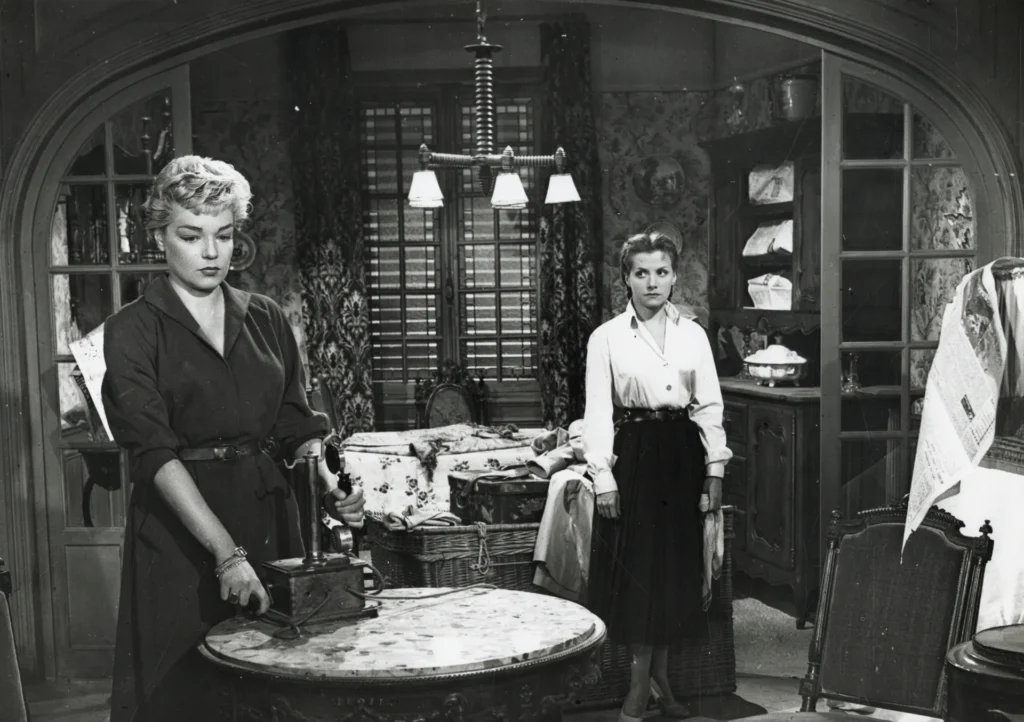
“Don’t be ‘diabolical’. Don’t spoil the enjoyment your friends might get from watching this film. Don’t tell them what you’ve seen.” If this is the plea that the film I diabolici makes to its audience, Adolfo Ceretti, Professor of Criminology at the University of Milan-Bicocca, can only disregard it in his analysis – as he himself jokingly points out before the ‘Diabolical Types’ masterclass held on 23 June at the Cineteca Milano Arlecchino.
It’s from a trilogy of films by Clouzot (Diabolique of ’55, Le Corbeau of ’43 and The Murderer Lives at Number 21 of ’42) that the criminologist draws inspiration to apply the methodological lenses of his discipline in an unusual, yet highly appropriate for the genre, combination with thepsychological analysis of the cinematic characters created by the French director, active between the 1940s and the 1970s. Small gestures, sidelong glances, postures, murmurs under one’s breath: Ceretti bases his reflection on Clouzot’s work on the physicality of his protagonists, and on how this reveals a ‘personal cosmogony’, a universe of inner meaning that the criminal personality constructs in relation to the outside world, often portrayed in the films as a closed, reactionary, petty-bourgeois world. Crime, in this sense, does not constitute a deviation from the natural order of things; on the contrary: it is onto crime that the very meaning of life of the perpetrator is projected.
It would, however, be more accurate to speak of ‘universes’, in the plural. The perpetrator of the crime is always accompanied by some other accomplice, through what are termed ‘mental mechanisms of the pair’ (or of the group): a series of thoughts, words and actions that acquire criminal potential by the mere fact of being shared.
In Clouzot’s films, the fictional narrative sometimes intertwines with a historical one, as in one of his most complex films, The Raven. The (fictional) story of a small town thrown into turmoil by the arrival of anonymous letters, which lead the townspeople to mistrust one another, is set against the extra-narrative backdrop of the Vichy Republic (the historical setting in which the film was shot), where collaboration with the Nazis, suspicion and denunciations were rife.
Ceretti thus characterises Clouzot’s cinema as a play of light and shadow which, however, does not conform to simple dichotomies: evil is always something diffuse and therefore difficult to pinpoint; the ghosts of the past are not entirely insubstantial; and the decisive act is never truly decisive.
Who is Henri-Georges Clouzot
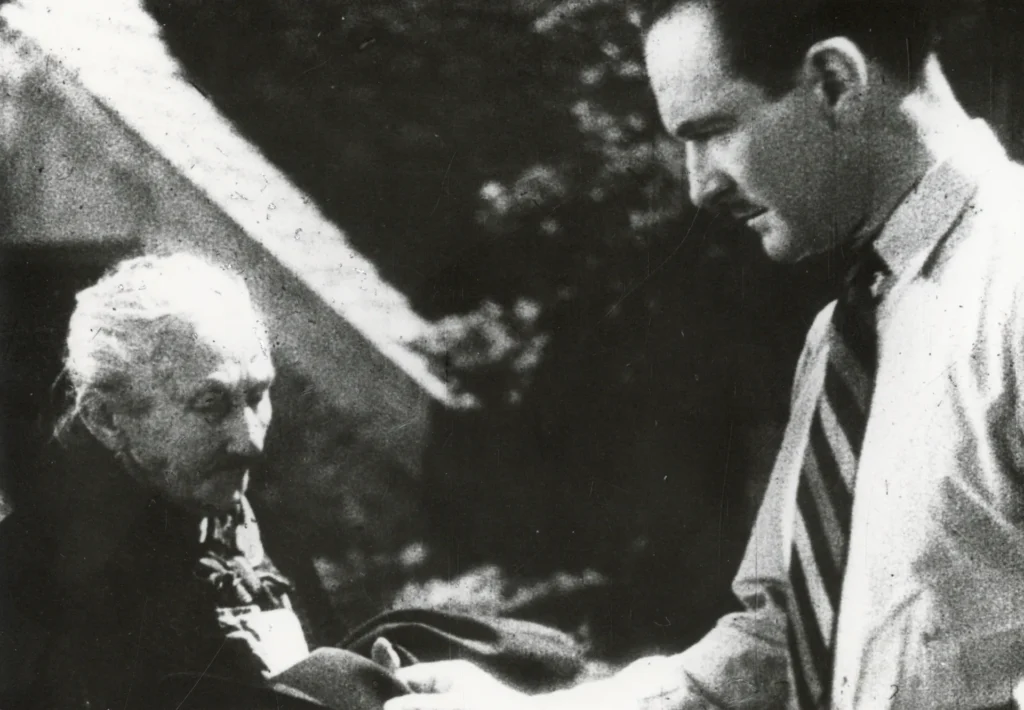
A French director and screenwriter (1907–1977), he is one of the leading figures of French film noir and the French thriller genre. In his films, he portrays a dark and violent world with a clear-eyed perspective, built on psychological tension and a scathing critique of bourgeois society.
Among his accolades: the International Award for Best Director at Venice in 1947 for Jenny Lamour; the Golden Lion at Venice in 1949 for Manon; the Palme d’Or at Cannes and the Golden Bear at Berlin in 1953 for The Wages of Fear; an Oscar nomination for Best Foreign Language Film for The Truth, 1960.