Christopher Nolan’s Personal and Divisive “Odyssey”
We interviewed Gabriele Galeotto, a high-school teacher of Italian, Greek and Latin literature, and Lorenzo De Stefano, a university lecturer in Digital Aesthetics, in an attempt to take stock of the cultural meaning of the film phenomenon of the year: Christopher Nolan's "The Odyssey"
by Orson Mariani and Cesario Marino Amabile
In a landscape where films often spend only a short time in theaters, some releases still manage to become events. When aversion of the Odyssey directed by Christopher Nolan was announced in December 2024, the meeting between a director who can draw a vast audience and one of the foundational texts of the Western tradition set expectations alive. The film’s long theatrical run and worldwide box-office success later confirmed the scale of the phenomenon, fueling a heated debate about the film. The real question, though, is this: does the work merely translate Homer’s poem into the blockbuster formula, or does it also manage to grapple with its cultural weight?
To try to answer, we turned to two scholars who grapple every day with the dialogue between ancient and contemporary culture: Gabriele Galeotto, a teacher and scholar of Italian, Greek and Latin literature at the Liceo Bartolomeo Zucchi in Monza, and Lorenzo De Stefano, a lecturer and scholar of Digital Aesthetics at the University of Naples Federico II.
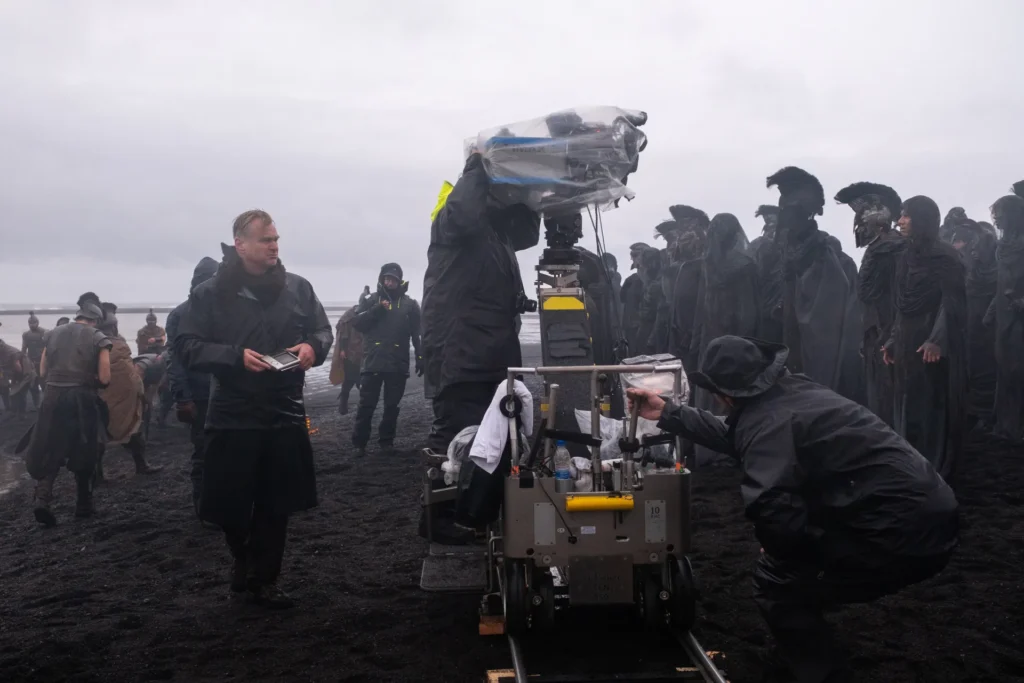
Christopher Nolan on the set of the film that grossed €59 million in Italy
From Poem to Screen
Like any film adaptation, the first question the film raises is its relationship with the original work. Nolan makes numerous changes: some are necessary and imperceptible cuts, while others are deliberate and significant variations. Galeotto, who is very open to contemporary reinterpretations of ancient works, recognises in the film a ‘two-track interpretative approach: a philological one, in which the more knowledgeable viewer engages critically with the original text, and a popular one, in which the less expert viewer simply enjoys an adventure story‘. While identifying certain commercial concessions that weaken the film, such as the clash with the Laestrygonians, which ‘looks like a scene from a video game‘, and the protracted slaughter of the suitors, Galeotto appreciates most of Nolan’s variations, such as the dead charging against the living and the reimagining of Circe, ‘very far removed from the Homeric text, yet decidedly evocative‘.
“I see the film as working on two interpretive levels: a philological one, where the more expert viewer engages critically with the original text, and a popular one, where the less expert viewer simply enjoys an adventure story”
— Gabriele Galeotto
De Stefano takes a harsher stance. In his view, the film distorts the poem to the extent of ‘raising doubts as to whether the director actually read the original work at all‘. At the heart of his critique is Odysseus, a man defined ‘no longer by his multifaceted wit, but by the torment of the horrors of war and the guilt of a petty conquest‘. De Stefano sees in this transformation a sensibility closer to the contemporary world than to antiquity, citing as an emblem the depiction of the famous trick of the Trojan horse: the ingenious idea that traditionally exemplifies Odysseus’s cunning and intellect is presented in Nolan’s film as a cumbersome contraption marked by glaring inefficiency, costing the lives of many men inside the structure itself.
A contemporary classic?
The debate thus shifts from the relationship between poem and film to that between antiquity and the present. Galeotto does not see the film as a necessary modernisation. Pointing out that the very first word of Homer’s epic is ‘man’, he recognises in the work a scope that is limited neither to antiquity nor to Hellenism, identifying an inherent universality capable of speaking to any era. According to Galeotto, ‘contemporary culture has changed greatly, but it has probably done so within a paradigm that precedes it and possesses a scope far greater than that which is specifically Greek and ancient‘. As an emblem of the idea that the Homeric poem may be the ‘product of a much broader Mediterranean culture‘, Galeotto cites the complex debate over the etymology of the name Odysseus, in which ‘many hypotheses exist, but none is unanimously accepted, and one even suggests that the name is not Greek at all‘.
De Stefano takes the opposing view, discerning a strong influence of contemporary culture in the reimagining of the work, to the point of arguing that it is ‘an American film, made by an (Anglo-)American director for American audiences‘. Highlighting the almost total absence of the gods—which detaches the story from the Greek world and brings it closer to the contemporary one, which ‘has killed its own gods and failed to replace them‘—De Stefano perceives in the film a representation of ‘the critical stance of American progressivism that appears to have gained mainstream acceptance, yesterday in the era of the atomic bomb and today in that of Artificial Intelligence‘. According to De Stefano, however, the work ultimately proves to be less a critique than an act of self-indulgence, since ‘Nolan offers no way out. The film concludes with the total absolution of the hero and the conclusion that things could not have been done otherwise, shifting onto future generations the burden of picking up the pieces‘.
“At the heart of ‘The Odyssey‘ is a man defined no longer by his many-sided ingenuity, but by the torment of the horror of war and the guilt of a petty conquest”
— Lorenzo De Stefano
From the destruction of Troy to the atomic bomb
This reading suggests a parallel between Odysseus and Robert Oppenheimer, the protagonist of Nolan’s previous film of 2023. Odysseus and Oppenheimer share the same fate: gifted with an exceptional intellect, they use it to end a war, unintentionally ushering in a devastating historical turning point whose first victims are themselves, overwhelmed by guilt.
The link between Oppenheimer and The Odyssey does not erase the differences between the two characters, but it offers a key to reading Nolan’s recent trajectory: an interest in men capable of extraordinary feats who cannot fully escape their consequences. It is perhaps here, more than in literal fidelity to the poem, that his version of the Odyssey seeks a confrontation with the present, whether or not it succeeds.
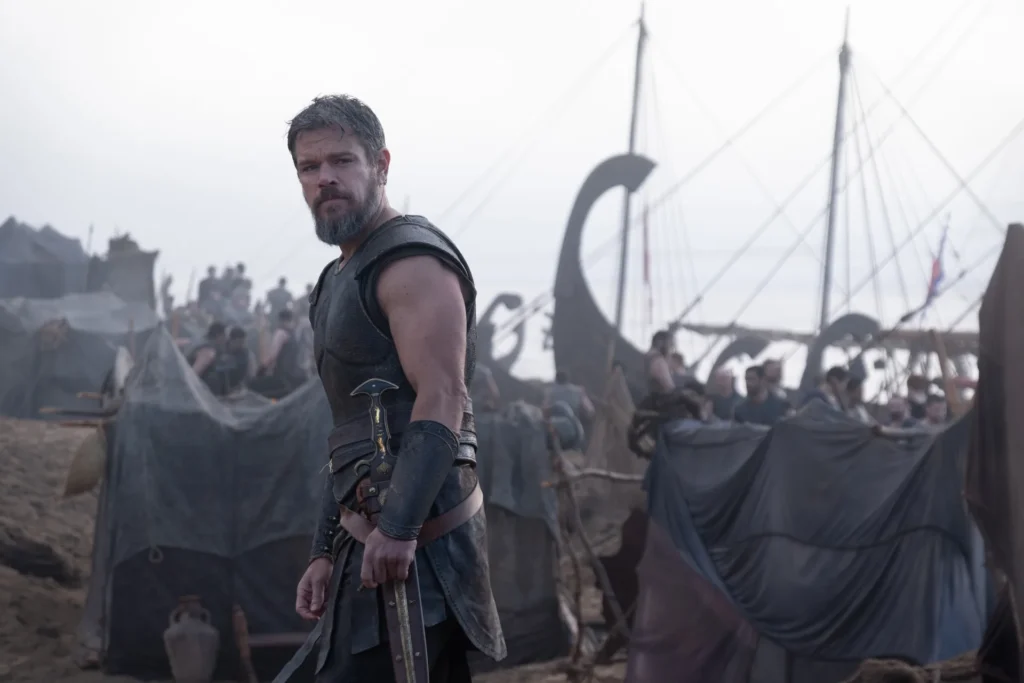
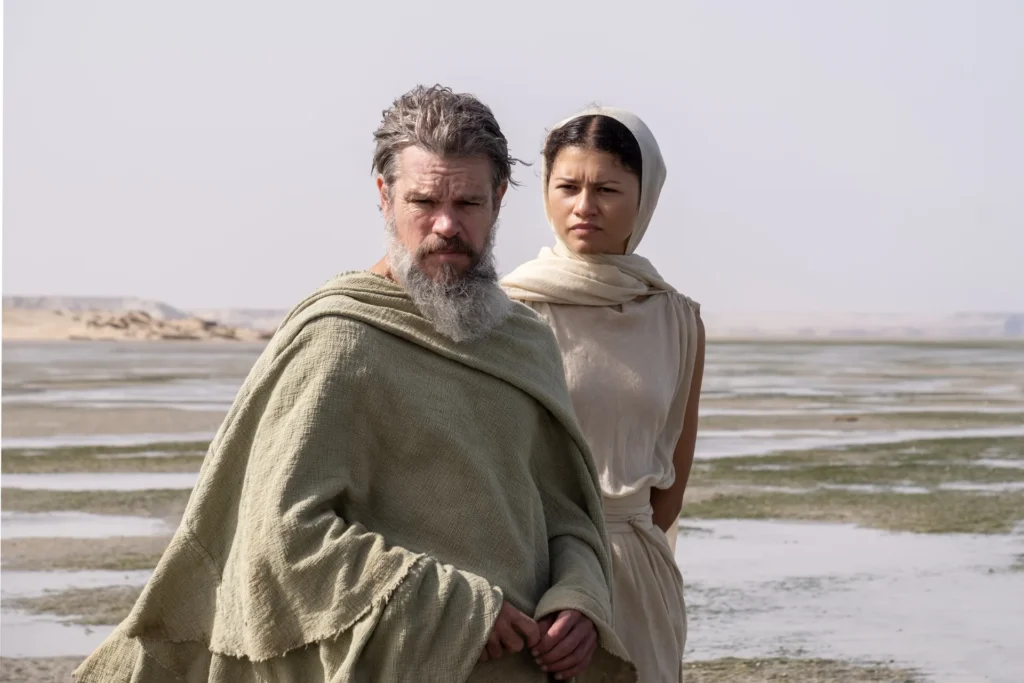
A close-up of Matt Damon. The American actor has been chosen by Christopher Nolan to play the Homeric hero OdysseusRobert Pattinson gave a convincing performance as Antinoüs, leader of the suitors and Penelope’s suitor in Odysseus’s absenceZendaya, pictured here with Matt Damon, played the goddess Athena
Per fornire le migliori esperienze, utilizziamo tecnologie come i cookie per memorizzare e/o accedere alle informazioni del dispositivo. Il consenso a queste tecnologie ci permetterà di elaborare dati come il comportamento di navigazione o ID unici su questo sito. Non acconsentire o ritirare il consenso può influire negativamente su alcune caratteristiche e funzioni.
Funzionale
Always active
L'archiviazione tecnica o l'accesso sono strettamente necessari al fine legittimo di consentire l'uso di un servizio specifico esplicitamente richiesto dall'abbonato o dall'utente, o al solo scopo di effettuare la trasmissione di una comunicazione su una rete di comunicazione elettronica.
Preferenze
L'archiviazione tecnica o l'accesso sono necessari per lo scopo legittimo di memorizzare le preferenze che non sono richieste dall'abbonato o dall'utente.
Statistiche
L'archiviazione tecnica o l'accesso che viene utilizzato esclusivamente per scopi statistici.L'archiviazione tecnica o l'accesso che viene utilizzato esclusivamente per scopi statistici anonimi. Senza un mandato di comparizione, una conformità volontaria da parte del vostro Fornitore di Servizi Internet, o ulteriori registrazioni da parte di terzi, le informazioni memorizzate o recuperate per questo scopo da sole non possono di solito essere utilizzate per l'identificazione.
Marketing
L'archiviazione tecnica o l'accesso sono necessari per creare profili di utenti per inviare pubblicità, o per tracciare l'utente su un sito web o su diversi siti web per scopi di marketing simili.