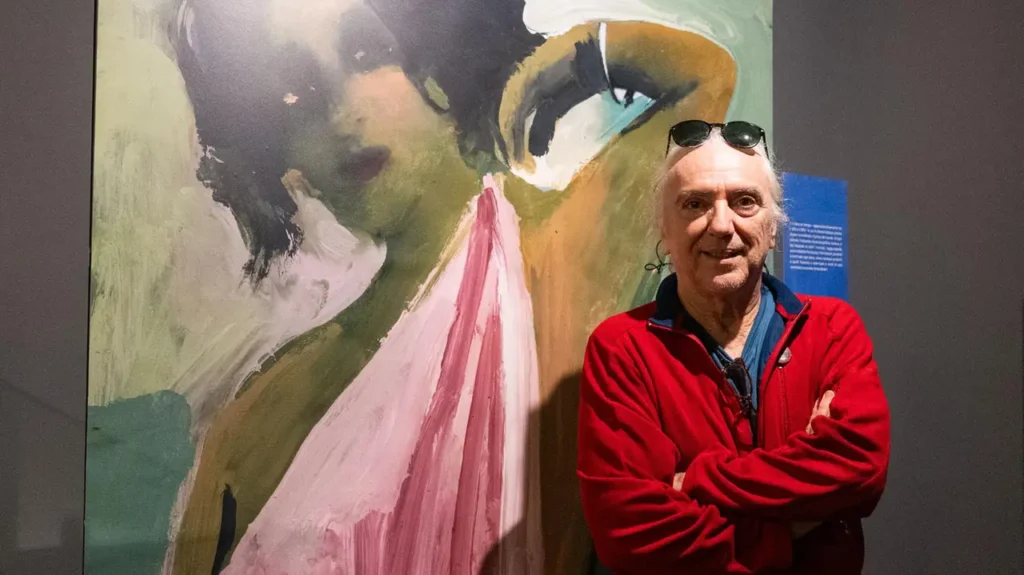
“Painting has always been my passion; I was born and brought up surrounded by colours, brushes and painting materials, whilst cinema has been a passion I’ve enjoyed as a viewer”. Thus begins the interview with Gianluigi Toccafondo, who spoke to us about his art, his working methods and how he follows his inspiration. “The cinema,” continues Toccafondo, “has always fascinated me. When the lights go down, it feels as though you’re inside a black box, and the level of concentration with which you watch the image projected onto the screen is far greater than in other exhibition spaces, such as museums or art galleries; but I’d never thought of doing anything with film; it was animation that sparked my interest: when I saw the first sequences projected onto the screen, I realised the potential of painting in motion.”
Were your studies in painting at the Academy of Art fundamental to your artistic development?
I attended art school but didn’t go on to art college or university. Film laboratories where film is developed and printed, moviolas, special-effects rigs, or pottery workshops with potter’s wheels and kilns, or printing presses for publishing, engraving and screen-printing… They have always fascinated me, and I have always learnt something in places where there is a direct relationship with materials. Pottery wheels and kilns are the places where things are experimented with and brought to life; the more you know about the materials, the more your ideas take shape and become inventions.
Throughout your career, as well as creating content for others – such as opening sequences and visual effects – you also directed several short films. Which aspect of the role of director fascinates you the most?
I don’t feel like a director; I wouldn’t know how to direct actors or other animators. Working with various directors, I’ve always learnt something: the irony and light-heartedness of Pietro Follini, with whom I worked on the Sambuca Molinari adverts; the rhythm, pace and power of Ridley Scott’s imagery when I animated the opening credits for “Robin Hood” and “Gladiator II”; Matteo Garrone’s handheld camerawork, which makes it feel as though you’re watching a boxing match with the actors – I worked as his assistant director on “Gomorra”; and Fabio Cherstich’s attention to the narrative dynamics of melodrama, with whom I’ve been collaborating for years at the Teatro dell’Opera. All my collaborations with other creators have always been opportunities for learning and exchange, and also a lovely way to escape the solitary and alienating work of an animator, where you spend months on end at your workbench talking to yourself. For some short films, I’ve done live-action footage to support the animation, but then I like to return to my desk, where I find my tools of the trade.
What are the main stages involved in making short films?
I print thousands of frames onto paper, transform them by gluing on cut-outs from engravings and photographs, and mix them with other film sequences; or I use trichloroethylene to transfer details from prints onto other images, like a collage of moving photographs – and then it all becomes painting. When I photograph the panels and put them in sequence, there are always unexpected issues: some scenes flow smoothly thanks to the use of live-action footage, whilst others feel more mechanical, but overall, I find the result very expressive, thanks in part to chance and improvisation. I hardly ever draw pencil storyboards, although I am sometimes forced to do so for certain commissioned works; I always start with a visual intuition, create small paintings, and write an outline to present a project. Sound is one of the most enjoyable stages of the work; it almost always comes at the end, so I’m free from the burden of thousands of drawings. For several short films, I’ve collected sounds and noises with a small recorder; it was like going fishing, just as I used to do at school with my notebook, taking notes from life with a pencil. A train in the distance, the whistles from the harbour or the sound of cicadas added depth and realism to the painted scenes; then the collaboration with musicians and singers served to complete and define the film; it’s the most fascinating and surprising part of the work.
The photographs of the divas from the D’Incerti collection played a key role in the exhibition. Which elements of the photographs you viewed in the archive struck you so deeply that you decided to dedicate an entire series of works to them, and how did you work with them?
The light in those photographs struck me deeply, as did the expressions, the eyes almost always fixed on the lens; the costumes and theatrical sets transported me straight into the world of melodrama. I photocopied and enlarged the images, then added colour, following and modifying the photographic material until I had transformed them into paintings, whilst trying not to erase their photographic essence: a glance, a pose, the light. This is how a relationship between photography and painting emerges. Acrylic paints allow me to achieve a robust, opaque texture whilst, at the same time, offering fluidity and transparency when the colours are applied very thinly. These two extremes allow me to create great depth and a three-dimensional quality that derives from the photographs.
The programme will feature the films you have loved the most. What was the guiding principle behind your choice of these titles? Is there any particular film you’d like to highlight?
If I had to choose the films I’ve loved the most, the works of Fritz Lang and Buñuel would certainly be among them. In this case, I’ve chosen films in which the characters undergo a transformation; from the boy in “Time of the Gypsies” to the little vampire in “Let Me In”. These are films that, once I’d left the cinema, left me with this sense of metamorphosis, which at times borders on the monstrous. Now that you mention it, I realise I’ve forgotten Comencini’s “Pinocchio“… It shaped my childhood and has always influenced my drawings.